|
Career
Path
1975 –
1978 Radio Inspector, Toronto District Office, DOC
1978 –
1979 Interference Suppression Technologist, Ontario Regional
Office, DOC
1979 –
1981 Technical Training Officer, Ontario Regional Office, DOC
1981 –
1982 Regional Manager Spectrum Control, Ontario Regional
Office, DOC
1982 –
1990 Director, Government Telecommunications Agency, Ontario
Region, DOC
1990 –
1993 Director General, Communications and Culture, Ontario
Region, DOC
1993 –
2007 Senior Director, Spectrum Management Operations, Ottawa,
IC
2007 –
2010 Director General, Spectrum Management Operations, Ottawa,
IC
|
Summary
In late 1974
Glen Worsnop, DOC District Manager in
Kitchener, along with counterparts from the Department of Transport and
the Public Service Commission came to Cambrian College in Sudbury to
interview third year electronic technology students for positions as Radio
Inspector trainees in the Ontario Region. As I was to later learn, it was
a period of rapid expansion for the DOC and there followed several years
of active college recruitment for “TIRLS”, a term used in the government’s
contract with IBEW, the union representing members of the Electronics
Group, denoting employees hired at the Technical Institute Recruitment
Level. TIRLs essentially underfilled the working level EL-04 Radio
Inspector positions during a well-defined and structured training program.
As a result of the interview at Cambrian both I and
Patrick Carrey received job offers and
upon graduation moved to Toronto to join the Toronto District Office under
supervisor John Nosotti. Patrick
also had a long career with DOC in the Toronto and Ottawa District Offices
and subsequently in Ottawa HQ.
Like the other TIRLs I followed a
structured training program designed to move one along a progression
through the levels EL-1, 2 and 3 to the “working level” Radio Inspector
EL-4. We accompanied Radio Inspectors “on the road” doing inspections
and interference work, spent time in authorization learning licensing,
learned monitoring in the Spectrum Observation Centre (SOC) and at the
Almonte Monitoring Station. I met pretty much the entire group of TIRLs onboard at the time in the Ontario Region at a two week TIRL
training session organized in Brantford by Bill
Willis. And of course there were endless hours of Morse Code
practice to attain 20 words per minute. To work on my code I picked up a
Yaesu FT-101E and was active on 20 metres for a period time. Although I
picked up the Advanced Amateur and Digital Radio certificates I didn’t
remain active in amateur radio.
About the time that I was
completing my Radio Inspector training the opportunity arose to apply for
one of the new EL-06 technologist positions in the Ontario Regional Office
(which was co-located with the Toronto District Office at 55 St. Clair
Avenue East). Also about this time I was asked to see newly-appointed
Regional Superintendent of Enforcement (later called Spectrum Control)
Mike Power who wished to speak with
me. Mike asked me about a document I had put together on audio
rectification to assist those experiencing this form of interference to
their audio devices. I didn’t attach much significance to the discussion
at the time but I later figured out that Mike
was scouting for the EL-06
competition he was about to launch. I was encouraged to apply even though
I had yet to even receive the official promotion to the “working level”
EL-04.
I was successful in the
EL-06 competition without having actually spent any time as an EL-04 which
was unusual. I had the good fortune of joining a great group under
Mike
Power consisting of Jenne Looper,
Bob Bissell,
Serge Bertuzzo and
Bill Willis. Most of my work dealt
with improving the private sector’s ability to assist members of the
public with their interference problems or obviating interference in the
first place. I also dealt with HQ personalities such as
Alex Windsor,
Maurice Drew and
John Ollerhead in mitigating instances of
cross-border interference with the US. When Bill retired I was asked to
take over his technical training responsibilities and at that time the
emphasis was on familiarizing our ELs with the rapidly emerging digital
communications technologies.
While in the Ontario
Regional Office I was mentored and given really helpful career advice and
support by Mike Power,
Gerry Brushett and
Dave Lyon. When
Mike transferred to the
Toronto District Office to be its Director following the retirement of
Bill Stone I was asked to act in his
position and won it in the ensuing staffing competition. As Regional
Manager of Spectrum Control I got to know my counterparts in the other
regions (in particular Maurice Nunas
who would later play a role in my move to Ottawa) and in Ottawa HQ during
the “SMOC” meetings including one in St. John’s featuring the infamous
cod-jigging excursion reported by “The Fly on the Wall” in the IBEW
newsletter.
In 1982
Bob Mitchell retired as Director,
Government Telecommunications in the region and to my great surprise
Dave
Lyon asked me to take his place which I did with a great deal of
trepidation given that it was a significant departure from my comfort zone
in spectrum management. It was a great time to assume the role given the
major challenge of the Local Shared Services Modernization project just
getting underway wherein the old step-by-step and crossbar telephone
switches were to be replaced by new digital switches such as Nortel’s
DMS-100 and SL-1. Terminal attachment deregulation had just happened and
as a consequence we were able to use competitive tender processes through
the Department of Supply and Services to source the new equipment and
obtain the best value for the government. We were also heavily involved in
the supply of telecommunications services in support of the Pope’s visit
and the Western Economic Summit. During the time that I was in this
position three different people served as Director General of GTA:
Guido
Henter, Micheline Desjardins-Chase and
John Gilbert.
When
Allister Pedersen
left the region’s Communications and Culture group in 1988 to work in the
MSAT program at the Communications Research Centre,
Dave Lyon asked me to
replace him. I was not at all interested as this field was quite far
removed from my background and interests and I turned down the offer.
Undaunted Dave asked me again with the same result but on the third
request I accepted. Dave was quite convincing and he was having some
serious problems in the delivery of those programs that was consuming much
of his time and he wanted me to fix things. This was quite a leap into the
world of grants and contributions and a clientele of well-known
personalities in Canada’s arts and cultural scene. We were frequently
accompanying the minister of the day (Flora MacDonald, Marcel Masse and
Perrin Beatty) to various events, openings and cheque presentations. Some
of the projects we supported were quite successful (renovations at the
Royal Ontario Museum and Elgin Winter Garden Theatre for example) and
others were not (the disastrous failure of ICOM, a telecommunications
museum in Brantford comes to mind).
As Director General,
Communications and Culture I figured that my next logical career move
would be to replace Gerry Brushett, who was Deputy Executive Director,
whenever he retired. However, in 1993 there was a major upheaval when the
new Liberal government was elected and promptly eliminated the Department
of Communications sending its programs to Public Works, Canadian Heritage
and Industry Canada. In the sorting out of the executives I was on course
to be in Canadian Heritage. About that time
Maurice Nunas announced that
he was leaving his position as Director, Spectrum Management Operations in
Industry Canada HQ to join the private sector.
Maurice called me to say
that I was on a very short list of people he had recommended to the
Director General of the Radiocommunication and Broadcasting Regulatory
Branch, Bob Jones, to replace him. I corresponded with Bob and he decided
to take me on and Deputy Minister Marc Rochon was very supportive of the
move when I spoke to him about it since he had the authority to do the
transfer. There were a lot of surplus EXs as a result of the new
arrangements and I recall Marc saying that “any landing spot is a good
spot”. I was relieved to be back on the spectrum side and happy to be
joining a number of people that were in Maurice’s directorate who I knew
well.
When I arrived in Ottawa
Bob Jones was mounting his successful campaign to be elected Director of
the Radiocommunication Bureau with the ITU in Geneva and as a consequence
he wasn’t around much and Jan Skora was often acting DG. Following Bob’s
election Jan won the DG position and he remained my DG until he retired in
2007 when I replaced him and the name of the branch was later changed to
the Spectrum Management Operations Branch which included all or the
regional operations. I was fortunate to be able to work with Assistant
Deputy Ministers like the legendary Mike Binder and
Helen MacDonald. The
spectrum work was both interesting and challenging and I had the
opportunity to work on many major files including antenna siting
procedures, licence fees, comparative licensing processes (and the ensuing
Telezone lawsuit), spectrum auctions, spectrum policy framework, program
rationalization, and spectrum management system modernization to name a
few. To the extent that I had any success it was largely due to the
efforts of a great staff of very competent people. I retired in 2010 after
35 years of service.
Michael Delamer Connolly
1 May 2017
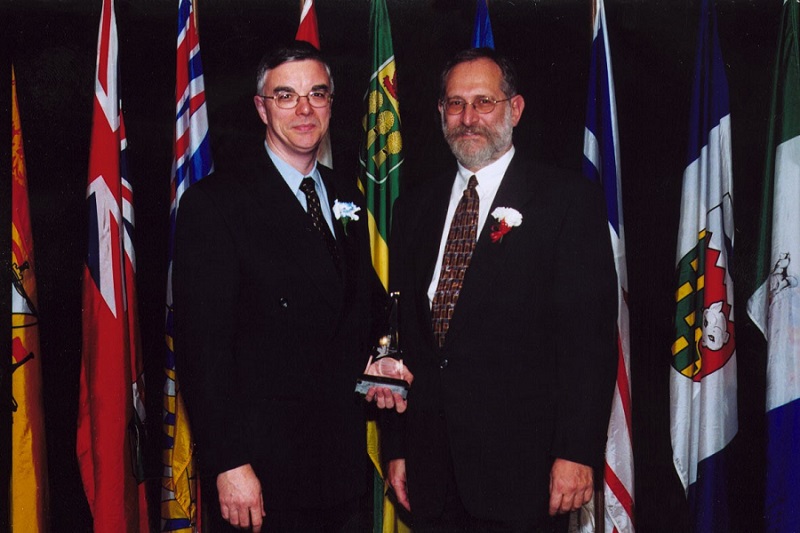
Clerk of the Privy Council Mel Cappe presenting the
Head of the Public Service Award for Excellence in Policy to Mike Connolly
in recognition for his work to introduce spectrum auctions in Canada,
December 2000.


Pounding Brass: A True Story
by Mike Connolly
One day in 1978 at the DOC Toronto
District Office, Radio Inspector George
Strongitharm received a call from an officer with the Metro
Toronto Police. The officer explained that they were investigating the
theft of a number of CB radios. They had a suspect and a rookie officer
had conducted a search of the suspect's apartment but the officer did not
find any stolen CB radios therein. The rookie did report the presence of
“an entire wall” of some other radio equipment however. The officer went
on to explain that, being a rookie, he had failed to record any details of
the equipment such as make, model or serial number so that it might be
checked against other reports of stolen goods. The officer was hoping that
DOC could gain access and get the information that the rookie had failed
to gather. It reminded me of what we were told by an RCMP officer on an
enforcement course we had attended. The officer had told us to be on the
lookout for anything suspicious during a search and note its presence.
George took down all the details
like the suspect’s name (let’s call him “SD”) and address etc.
George could find no record of the suspect in any databases. There was some
discussion in the office and Bill Hall,
who had formerly been with CSE, called a contact at the RCMP as Yugoslavia
was a Communist country however SD was not anyone on the RCMP radar.
Supervisor John Nosotti decided
that George would investigate by inspecting the installation.
John also
decided to send Patrick Carrey and me
to accompany George given the circumstances.
So off we went one evening to the
suspect's apartment building near Morningside and Ellesmere in
Scarborough. Before heading up on the elevator we headed down to the
underground parking as the Metro Police had given George details on SD's
vehicle. We found it easily enough and observed a 2 metre rig installed
therein. Then we headed up to the apartment which as it turns out was on
the top floor of the 20 storey building.
George knocked on SD's door and it
was answered by the man himself. George
identified himself and explained
he was there to inspect the radio equipment reported by the Metro Police.
SD permitted us entry. We immediately saw a large wall unit in the living
room fully populated by amateur radio equipment including transmitter,
receiver, slow scan TV and a teletype and other stuff that I don’t recall.
We also noted that there was a large vertical antenna mounted on the
balcony the top of which extended up past the roof of the apartment
building quite close to the wall. Pat and I set about recording all the
details of the installation while George spoke with SD.
George asked SD if he had a radio
licence for the equipment and he did not.
George asked him if he had an
amateur radio operator’s certificate and SD said that he had one from
Yugoslavia and he produced a paper written entirely in Yugoslavian.
George explained the Radio Act requirements and the penalties for noncompliance
and how to go about complying. SD gave
George every assurance that he
would comply. George said he was taking the Yugoslavian certificate. Later
George had it translated and it turned out to not be a certificate but
rather a membership in a Yugoslavian amateur radio club.
George asked SD
if he had any other radio equipment and SD said no he did not. Then
George asked him about the 2 metre rig in the car and SD sheepishly admitted that
it was also his.
Pat
and I finished up with the
equipment and we left. We passed along all the information that we had
gathered on the radio equipment in SD’s apartment to the police but none
of it had been reported as stolen.
A week or two later
John Nosotti was
reviewing the recently received interference complaint cards when he
noticed that one was for the same address, and even the same floor, as
where we had paid the visit to SD. From the description it was evident
that the complainant’s audio equipment was suffering from audio
rectification and it was also evident that SD had not heeded
George’s
admonitions about obtaining an amateur radio operator’s certificate and
licence prior to operating again. John instructed Pat and me to gather
sufficient evidence to bring charges for unlicensed operation against SD.
Based on the interference
complainant’s report we noted that SD was usually transmitting most
evenings so Pat and I chose an evening to return to SD’s apartment
building. Having seen the installation we knew that the vertical antenna
conveniently extended from the balcony to just above the roof of the
building and close enough to the edge that one could actually reach out
and touch it. So we positioned ourselves on the rooftop and set up our
gear. First we attached an RF ammeter used in ship inspections to the
antenna with the other lead clipped on to the roof flashing which we
figured would be grounded somewhere given the height of the building. The
RF ammeter would likely register some reading if the antenna was
energized. Then we set up a Fluke frequency counter with a short whip
antenna anticipating that it would register the frequency of the
transmission in the same way that we usually used the instrument when
performing inspections. We also set up a field strength meter as yet
another indication of an operating transmitter. Once set up we started our
vigil waiting for SD to fire up the transmitter so we could observe and
record the instruments.
We waited for well over an hour with
no activity on the instruments whatsoever. We started wondering if SD was
even at home and whether we were wasting our time. Rather than carry on
waiting I said to Pat that if he held on to my ankles I would hang over
the edge of the roof upside down and look into SD’s apartment to see if
there was any sign of life. Pat agreed readily.
So over I went with
Pat having a firm grasp of my ankles.
Sure enough I could hang down low enough to have a view through the patio
doors and into the apartment. I immediately spotted SD. He was laying on
the couch – wearing nothing – with a copy of Penthouse magazine
and he was
not pounding brass! I signalled frantically to
Pat to haul me back up which he did. Once back on the roof I
ran clear across to the other side of the building and started laughing
hysterically. I told Pat what I had
seen. Pat didn’t believe me and
figured that I was just joking around to break the monotony. I offered to
hold his ankles and he could see for himself.
Pat then hung over the edge of the roof while I hung on to his ankles. Soon he
was signalling to be hauled up upon which he ran across the roof and
started laughing like crazy.
Once we had stopped laughing we
decided that there was unlikely that there would be any transmitting going
on so we packed up all the gear and called it a night. The next day we
dutifully reported the results to John
Nosotti. I am not sure if John’s
face was the result of hearing that we had hung upside down over the edge
of a 20 storey roof or as a result of what we had reported seeing. It was
a curious mixture of incredulity and amusement.
We never had occasion to go back to
that apartment building and we didn’t have to face SD. I think he moved
away or something thus solving the problem. On various occasions
Pat would prompt me to tell the “Pounding
Brass” story.
Years later ADM
Rob Gordon visited the Ontario
Regional Office as part of a farewell tour of sorts as he had announced
that he was retiring from DOC. We were at Dave
Lyon’s place and I told him the story of how
Pat and I had conducted our rooftop
investigation. Rob looked at me
and said “Pat Carrey? The same
Pat Carrey that works in DOS in Ottawa?”
He couldn’t believe that the Pat Carrey
he knew to be such a serious and responsible manager would have been
involved in such an escapade. I guess he didn’t know
Pat as well as he thought!
Mike Connolly
28 September 2017