Below is
my file on Ron Hook, who was the father of the radio network in Northern
Saskatchewan and who was recognized by the Telecom Hall of Fame a few years
ago.
Back
around 1973 I was in LaRonge, Saskatchewan with Charles Feaver and was
introduced to Ron Hook. When Ron received the Hall of Fame award Charles
showed an interest and a year or so ago he came across one of the original
sets which Ron Hook had built (or modified) for the network. We had been
trying to find a home for the set. Jack Anderson was helping us find a home
and had discovered that the museum in Prince Albert actually had a section
dedicated to the Department of Northern Saskatchewan so that would be a
natural place for the set.
It has
been left to me to work things out with the Museum. With Jack`s passing I will
probably ask Ken Leek, who was with me at the JAWS, to act as our local
contact. Charles Feaver (a good friend of Ron Robbins) is heading up there in
the summer and will deliver the set. (Charles Feaver
delivered the radio set to the Prince Albert Historical Museum in May 2012.
Click on the link at the bottom of this page for more info)

Ron Hook: Father of Communications in
Northern Saskatchewan
Introduction
Ron Hook for many years ran the communications
network for Northern Saskatchewan out of Prince Albert. He developed and built
the northern communications network: made the radio sets, installed and
maintained them for some 40 years prior to the mid 1970s when first the
Department of Northern Saskatchewan (DNS) and then SaskTel assumed this
responsibility.
The Context
In August
2002, Saskatchewan
Northern Affairs published Northern Saskatchewan – A Transformation
outlining the establishment of infrastructure in Northern
Saskatchewan.
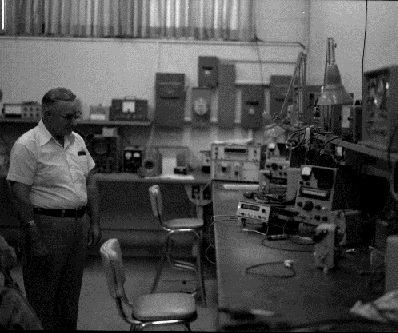
Ron Hook
in his workshop - July 1975
This document
records “[An] area of service to the North where
Saskatchewan became an international leader was radio communications. The
government created the Radio Branch of the Department of Natural Resources.
Until that time, northerners had to rely on primitive radio equipment used by
various agencies without the benefit of a formal network of stations to serve
the needs of industry, government and individual citizens.
In addition to improving emergency services and
introducing a public “radiogram” service, the Radio Branch aided in medical
services, forest fire suppression, weather data for aircraft, and logistical
support for the many business activities
that had developed. Later, trappers and others working “on the land” were rented
portable equipment to maintain radio communication links.
In support of improved communications to and among
northern communities, the Department of Natural Resources also initiated a daily
radio broadcast (“Northern News”) aired on the Prince Albert radio station CKBI.
Northerners would faithfully listen to the program to receive market and
community information and personal messages – essential communication in the
days before telephone service was available to northern homes.”
A Type 15 (one of the radio sets) in Stanley
Mission with operator Murdoch Charles, who would chat with all the trappers, and
then at night tell them to save their batteries while he told them the news of
what was going on in town and an old story or two.
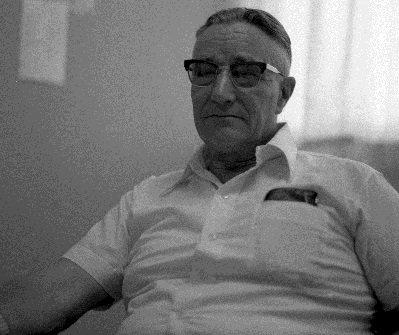
Ron Hook
- 1975
A Testimonial
Brian Cousins, Director, Northern News Service
Branch of the Department of Northern Saskatchewan in the 70’s writes: “I
cannot think of anyone so deserving (as Ron) for [a] nomination. Ron Hook's
pioneering work (which was far ahead of what was being done in other
northern/remote areas) attracted interest from other jurisdictions and
certainly impressed the Motorola company as Ron applied their equipment well
beyond what the company had previously thought possible.
It is regrettable that this chapter of Canadian
communications development has not received the recognition it deserves -
especially the work of Ron and the colleagues he led and inspired. I only
worked with Ron during the DNS days, after his initial communications
development work had been undertaken in earlier years. But even in the 70s,
Ron frequently had to ensure that "newcomers" like me (and the wizards at
SaskTel) were made aware of how radio communications worked in the North and
the realities of remote communications - technically and socially.
The Scope of Ron’s Contribution
The scope of Ron’s responsibilities, then at the
end of his long career, is captured in the Department of Northern
Saskatchewan’s 1973-74 Annual Report.
“..the Radio Communications Division
(transferred from the Department of Natural Resources in April 1973 under the
supervision of Ron Hook). The objectives [of the Division] were:
-to meet the radio communications requirements
of the Department of Northern Saskatchewan, the Department of Natural
Resources and individuals and groups in northern Saskatchewan where alternate
communications facilities are not available.
-to foster improved communications and
information exchange among northern communities, the department and the
public.
-to recommend effective use and development of
media in the north.
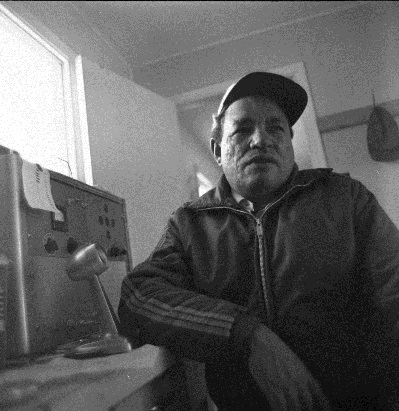
Charles
Murdoch - 1972 - A
colleague of Ron Hook
Effective communication is essential in northern
Saskatchewan to co-ordinate forest fire suppression, resource administration and
other department activities and to contribute generally to daily life in the
north.
Ten key or control stations, which serve as
clearing centres for the handling of radiograms, were operated at Uranium City,
Stony Rapids, Brabant Lake, Cree Lake, Buffalo Narrows, La Ronge, Divide, Beaver
Lake, Prince Albert and Hudson Bay.
The Departments of Northern Saskatchewan and
Natural resources use the radio communications network extensively for general
administration purposes. Other government departments and agencies, such as the
Northern Municipal Council and the Northern School Board, also use it for
communication in the north.
The entire forest fire protection and suppression
program in the north and in provincial parks and recreational areas is carried
out through radio communications using portable, mobile, air-borne and base
station equipment.
Radiogram message facilities and rental of radio
equipment was made available to the public and the various government agencies.
These facilities were used extensively by trappers, fishermen, Indian bands,
tourist outfitters, logging camp operators and residents of the north.”
Ron’s retirement celebrations in 1977 tell
something of his contribution.
“Ron Hook, the man responsible for the
communications network in northern Saskatchewan, has retired after 40 years of
service.
Born in England, Ron moved to Canada and in 1937
began work for the Saskatchewan government as a tower-man at Thunder Mountain.
Then he got interested in radio communications and
began building radios which could be used under northern conditions.
He salvaged parts from older radios and built the parts he was missing. The
network eventually linked all parts of the North and includes forest fire
fighting communications and radios in the southern provincial parks.
As part of the retirement celebrations, all the
radio operators from across the North met inn Prince Albert for a one-day
conference. It was the first meeting held since the network was established and
some of the operators had been talking to each other on the radio for 30 years
but had never met face to face.
At the retirement party, Ron was presented gifts
by the radio technicians, the radio operators, DNS and the provincial
government. DNS Minister Ted Bowerman, Deputy Minister Marcel L’Heureux and
former deputy Wilf Churchman all addressed the crowd of about 150 people.
Ron and his wife have decided to spend their
retirement in Prince Albert and area.”
The Legacy
Following on the pioneering work of Ron Hook,
Northern
Saskatchewan – A Transformation was able to report that “Over an
eight-year period to the end of 1981, the provincial government had developed an
impressive list of northern achievements [including] the extension of SaskTel
microwave service from 24 per cent to
97
per cent of the population helping to increase access to CBC
radio and television from
15 per cent to
96
per cent.
Persons consulted
Graham Guest, Archival Historian, Northern
Saskatchewan
Through Graham Guest, a friend of his named Tom
Roberts, who worked for DNS in the early days, said to call John Kushneryk who
had he worked with Ron. Graham called John who said Ron is his neighbour!
Graham also spoke directly with Ron Hook.
Brian Cousins, Previous Director, Northern News
Service Branch
Mr. Jim Hutch P.ENG, (Ex-President Saskatchewan
Research Council)
Maureen Matthews and Charles Feaver, Winnipeg
(knew Ron Hook at La Ronge)
Don Ching- until last year Pres/CEO of Sasktel now
Pres/CEO of Areva Canada
Version 1
John
Gilbert
7 May 2007
This nomination draws
from communications with people who have lived and worked in Northern
Saskatchewan. Additional information is available from the
N. Sask Archives which has a large collection
of print materials and photos from the Dept of N. Sask days. DNS prepared
annual reports that updated the activities of the Radio Communications
Division each year. Amongst the DNS slides there are several photos of Ron
and the activities of the radio division. Denosa also contains
several articles featuring the radio operators on the network.


