from
Peter Rakobowchuk, The Canadian Press, September 26, 2013
MONTREAL
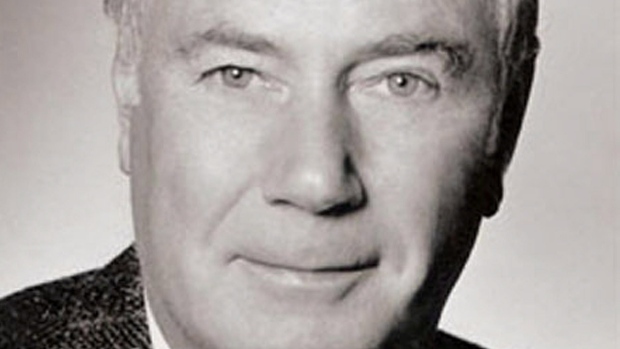
-- Philip Lapp, whose string of contributions to Canada's space program over a
half-century included helping to build the first Canadarm, has passed away at
the age of 85. His wife Colleen Lapp told The Canadian Press that her husband
died in hospital near Toronto on Wednesday after a long illness.
The
aeronautical engineer's list of achievements included helping to build
Canada's first satellite; working on the early NASA capsules; co-founding SPAR
Aerospace, which built the first Canadarm; and co-authoring major space
policy.
But he
didn't brag about it.
“We
didn't blow that horn loudly,'' Lapp said in a 2011 interview with The
Canadian Press, describing his contribution to the antennaes for NASA's
Mercury, Gemini and Apollo space capsules. “Probably we should have. But this
is the Canadian way, you know. So we didn't make the exaggerated statements
that you hear from other parts of the world.''
Lapp was
instrumental in the construction of Alouette -- Canada's first satellite,
which led the country to become the third nation in space after the United
States and the Soviet Union. He also helped establish the Canadian
Astronautical Society, the predecessor to the Canadian Aeronautics and Space
Institute.
His wife
lauded his human side in an interview Thursday. “He was just a really bright
man,'' Colleen Lapp said.
“But he
had a common touch... He got along with everyone.''
He
volunteered his time as a member of the board of the Canadian Air and Space
museum in Toronto until he became ill. Robert Godwin, who served as the
museum's space curator, said Lapp leaves behind a huge legacy.
“His
hand was in so many of these different things that we now attribute to our
Canadian air and space program,'' Godwin said in an interview from Toronto.
Lapp got
his start doing his thesis in the U.S. at MIT on long-range ballistic missiles
in the 1950s. He designed the guidance system for one of the first rockets the
Americans developed, under the classified Atlas program, and says he returned
to Canada “with a lot of space stuff in my head.''
Godwin
also said Lapp co-authored the “Chapman report'' which launched Canada's space
policy in 1967 and which, he added, has influenced Canada's space program ever
since. But he said what really struck him was that, despite his list of
accomplishments, Lapp was a quiet and humble man. “He was so soft-spoken, did
not blow his own horn, but when he spoke people tended to listen because
usually what he said was worth hearing,'' Godwin said. “It was always a quiet,
calm, considered opinion and you can tell you were getting sage advice when
Phil spoke.''
In the
2011 Canadian Press interview, Lapp discussed the 50th anniversary of the
historic first human space flight by Russian cosmonaut Yuri Gagarin. He
admitted that he admired the Russians back then even though he was frustrated
because they had more success with their rockets than the Americans. “When
Gagarin was in orbit, it's probably fair enough to say that I was probably
frustrated that we, the western world, were beaten by the Russians again with
putting a man in space,'' Lapp said. “That was quite an achievement. I had to
mix my feelings with an admiration that the Russians were able to do it.''
Lapp was
working with a group of young engineers at the De Havilland aircraft company
in the 1950s and early '60s at its Guided Missile Division, just outside
Toronto.
Lapp,
who was appointed an Officer of the Order of Canada in 1995, leaves behind a
wife, stepdaughter, and two sons and a daughter from a previous marriage.
Correction: The Canadian Press erroneously reported Sept. 26 that Philip Lapp
was the head of mechanical engineering on the Avro Arrow (CF-105). In fact,
Lapp did not hold that position.