
one of them ... ( VE4QR )
Arranged for the web from
personal correspondence 2006-2009
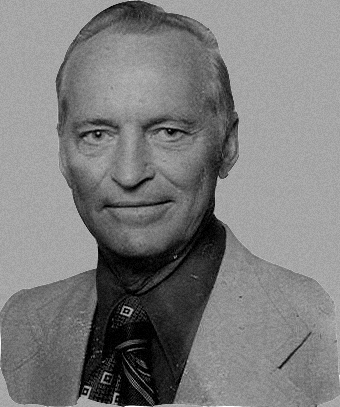 Eric Shea was born
in South Saskatchewan and grew up during the (
Dirty 30's ) and the Great
Depression. Since that did not seem to be the greatest place to live at that
time, he took the first opportunity to leave Saskatchewan and attended radio school
in Winnipeg to obtain a Second Class Operator Certificate.
In 1942 , Eric was first assigned to the Winnipeg
Monitoring Station which had been relocated from the small town of Forrest,
Manitoba early in the war.
As
at the other stations across Canada it was involved in interception of enemy
radio signals – to copy marine traffic primarily, particularly from German
coast stations and with a high interest in U-boat signals. Additionally some
neutral country ships were monitored for position reports as there was some
suspicion that some of these ships were re-supplying and refueling German.
On the rare occasions when a submarine signal was
intercepted, it also meant to obtain Direction finder bearings -
transmissions from subs were of very short duration and only consisted of a
few code groups so speed at obtaining a bearing was required. Staffing at
the station was about thirty two operators working 8 hour shifts.
Late in 1944, after the U-boat problem was somewhat
diminished, some of the interception work was transferred to the Japanese
war and this entailed the copying of Kana code. This code consisted of 56
characters in lieu of our 26 and consequently was only printable using two
of our letters - this consisting normally of a consonant followed by a
vowel.. While our alphabet is made of up to four dot/dash combinations, KANA
code was primarily composed of five dot/dash combinations and some of up to
six. While this may appear difficult, it was a fairly
easy transition for operators proficient in the copy of normal code signals
and many Japanese stations were operating at a fairly slow transmission
speed. A standard keyboard typewriter was utilized at all Canadian stations
and it was not considered an advantage to acquire the Navy developed
typewriter with a keyboard designed for Kana code.
(
The KANA code )
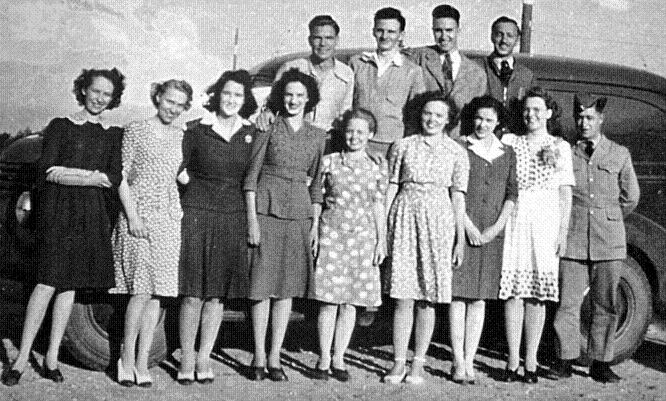
Change of shift at the Winnipeg
Monitoring Station during World War II
Since there was an advantage for reception of
Japanese signals at the west coast it was decided to increase staffing at
the Lulu Island Monitoring Station (Point Grey had been the original
monitoring station at the west coast and continued to operate – Lulu Island
was established specifically as an interception station).
Early in 1945 Operators from a number of monitoring
stations
across Canada were transferred to that location. Some of the Japanese transmissions were now at high
speed and it was necessary to record the signals and replay at a slower
speed. This was much prior to development of tape recorders and recording
was done on
cylinders rather than flat discs as used in the mechanical phonograph in
use at that time. The recording quality was extremely poor but adequate for
code.
Eric and some of the operators were then
transferred to a station on Lulu Island (Vancouver) to copy this Japanese
Kana code.

But the work of intercepting Kana code was of short
duration as the war in the Pacific ended in August 1945 and most of the
monitoring operators were relocated primarily to Radio Range Stations across
the Regions.
Eric was then transferred to Lethbridge and later to
North Battleford.
In 1951 following the retirement of Harold Tee ,
Eric obtained a Radio Inspector position in Regina (not a desirable job at
that time since part of the work was dealing with Broadcast receiver
licensing and prosecutions but at least it was the end of shift work).
In the early 50's, each province had a supervising
Radio Inspector reporting directly to HQ in Ottawa. Fortunately Broadcast
receiver licensing was discontinued at the end of 1953.
Continuing, in 1954 the Radio Regulations division
was reorganized into Regions corresponding to the other divisions of the
Dept. of Transport and Eric was transferred to the Winnipeg Regional office
and became the Regional Supt. in 1964.
Radio Regulations separated from DOT in 1969 and
the Central Region was established in the Dept. of Communications with new
boundaries which included Manitoba, Saskatchewan, Alberta and most of the
NWT. In addition to eight District Offices it had responsibilities for
Monitoring Stations at Melville, Wetaskiwin, and Fort Smith as well as
Ionospheric stations at Resolute Bay, Baker Lake, Churchill and Headingly.
Work in Spectrum Management was always interesting
to him. In those years, much of the licensing and frequency allocations had
been decentralized to the Regions and required contacts with all agencies
making use of the spectrum. Changes in electronic technology had been
dramatic during his working period and went from elementary vacuum tubes to
solid state and integrated circuitry with color TV, Microwave, Satellites
and cell phones.
Eric retired in 1978 after 36 years and continued
with some travel, golf, curling and amateur radio (VE4QR)
Acknowledgements: Photos with thanks to
Ed Good and
Lorne
Greenwood.


It
is with the deepest sorrow that we announce the passing of our beloved father,
grandfather and great grandfather Eric Robert Shea on Saturday, October 29, 2011
at the Grace Hospital at the age of 88 years.
Eric was predeceased by his wife Olga in 2009 and leaves to mourn his passing
his children Diane, Candice, Tim (Laura) and Rob (Roz). He is also survived by
his six grandchildren Kelly, Paul, Jessie, Benjamin, Danielle and Krista, five
great grandchildren, one sister and many nieces and nephews.
Eric was born on August 6, 1923 in Lampman, Saskatchewan and resided in Winnipeg
the majority of his adult life. He worked for the Federal Department of
Communications until his retirement.
Eric enjoyed life to the fullest and golfing and curling were near and dear to
his heart. Upon his retirement he travelled south every winter to “test” the
golf courses. He especially loved cheering for his Bombers and was in attendance
at all their games. He also liked to attend the Goldeye games and cheer them on
to victory.
He will be deeply missed by his family who were of utmost importance to him as
he was to them with his wonderful sense of humour and kindness.


